Wednesday, February 1, 2012

PARIS - Architecture Smorgasbord


Notre Dame Cathedral 2010 by DG Hudson

Man has always strived for beauty in his cathedrals and churches, though what was stylish in one era is considered dated a few hundred years later. Regardless of style, we can appreciate the buildings for the detail, the statues, the beautiful stained glass windows and the graceful arches of the exteriors. 

This post highlights a few of the churches and other interesting buildings we saw on our walks around Paris. There are numerous websites for those wanting more information. This is just a sampling, a smorgasbord.


Fearsome Waterspouts of Notre Dame by DGH


Notre Dame Cathedral

Notre Dame de Paris (Our Lady of Paris) completed in 1345, boasts individually made gargoyles and was one of the early churches incorporating flying buttresses. At one time, the exterior and the detail were painted, rather than the stone grey they appear today. It’s a building of interest from every side, with a beautiful circular stained-glass window in the front between the two towers. (Link below for interior photos).

A large square facing the front of the cathedral is a common gathering place for tourists, locals wanting to catch some sun while having their lunch, and the pigeons hoping to catch a few crumbs. The large statue of Charlemagne on one side watches over the square. The Crypt Archeologique, a home for the Roman ruins found beneath the area, resides in another corner.


Charlemagne in Notre Dame square - by DG Hudson


http://en.wikipedia.org/wiki/Notre_Dame_de_Paris  Notre Dame Cathedral

***
Sacré-Cœur Basilica

Montmartre's highlight at the top of the hill.


Sacré-Cœur - Montmartre, Paris - by DG Hudson

Sacré-Cœur Basilica (Sacred Heart) at the top of Montmartre butte towers over the city of Paris, the stark white of the stone shining against the blue sky. This travertine stone cleans itself as it exudes calcite, a nice touch. The basilica construction started in 1875, in what was considered a rebellious section of the city, and was completed in 1914.

Wide steps at the front of the church allow visitors to rest and enjoy the vista before going inside the basilica or making their way back down through the winding streets of Montmartre. 

Remember the Da Vinci Code?


Sacré-Cœur, Montmartre, Paris - by DG Hudson

http://en.wikipedia.org/wiki/Basilique_du_Sacr%C3%A9-C%C5%93ur,_Paris Sacré-Cœur Basilica

http://www.aviewoncities.com/paris/sacrecoeur.htm  A View on Cities

***


St. Germaine des Pres


The Bell Tower of St. Germaine des Pres - by Green Eye

The Church of St. Germaine des Pres, built in 542 AD to house holy relics, is the oldest church in Paris.  It's on the Left Bank in the 6th arrondisement. The church combines Gothic style with the Romanesque design of the older part of the church, a nave and the last bell tower. 

René Descartes, the philosopher-mathematician, is buried in this church. Just down the street is the famed Les Deux Magots, and around the corner the equally famed Café Flore. Not a bad neighbourhood.

http://en.wikipedia.org/wiki/Saint-Germain-des-Pr%C3%A9s  St. Germaine des Pres

http://www.french-at-a-touch.com/French_Regions/Ile-de-France/saint_germaine.htm  French at a touch web site


***

Versailles

Gilt at the palace of the Sun King.


In the inner courtyard at Versailles by DGH

 ***
 
Place du Châtelet  - On the Right Bank between the 1st and 4th Arrondisements  stands the tower below.   This is how it looked in 2010 with the sun behind.


Place du Chatelet near Les Halles - by Green Eye


***
 
Arc de Triomphe
 
Under the arches of the Arc de Triomphe are inscribed names of battles fought during the Napoleonic era.  The grave of the Unknown Soldier rests beneath here. 


Arc de Triomphe - History etched in stone - by DGH

 
***
 
Musee D'Orsay
 
A former Paris - Orleans Railway station now serves as a beautiful art gallery for Impressionist art.  Some other styles do make a showing.  No photos are allowed inside the gallery in order to preserve the art.  This building is the inspiration for the one featured in the movie, Hugo.
 

Musee D'Orsay Detail, Left Bank, Paris - by DG Hudson


***
 
What are some distinctive landmarks for the city you live in or a place you like to visit? 
 
Most places have at least one unique feature.  Key West has a large conch shell welcoming you to the city (called the Conch Republic for a short time).  Landmarks can be buildings, statues, or retro advert pieces still standing.  Can you name one?
 
*****

Sunday, January 1, 2012

PARIS - Père Lachaise Cemetery

Père Lachaise Cemetery, 20th Arrondisement, Paris - DGH


Père Lachaise Cemetery, (or Cimetière du Père-Lachaise) established by Napoleon in 1804, is reputed to be the largest cemetery in the city of Paris with its own stone cobbled streets and snug juxtaposition of memorials. Large memorials dedicated to those who served in previous wars stand here, beside family memorials and ornate tombs of some of history’s most celebrated cultural heroes. The various styles of architecture shown in some of the memorials give us an idea of their age, as well as the materials used: marble, granite, iron sculpture, bronze figures, and stained glass inserts.


Beautiful detail made to survive - by DG Hudson


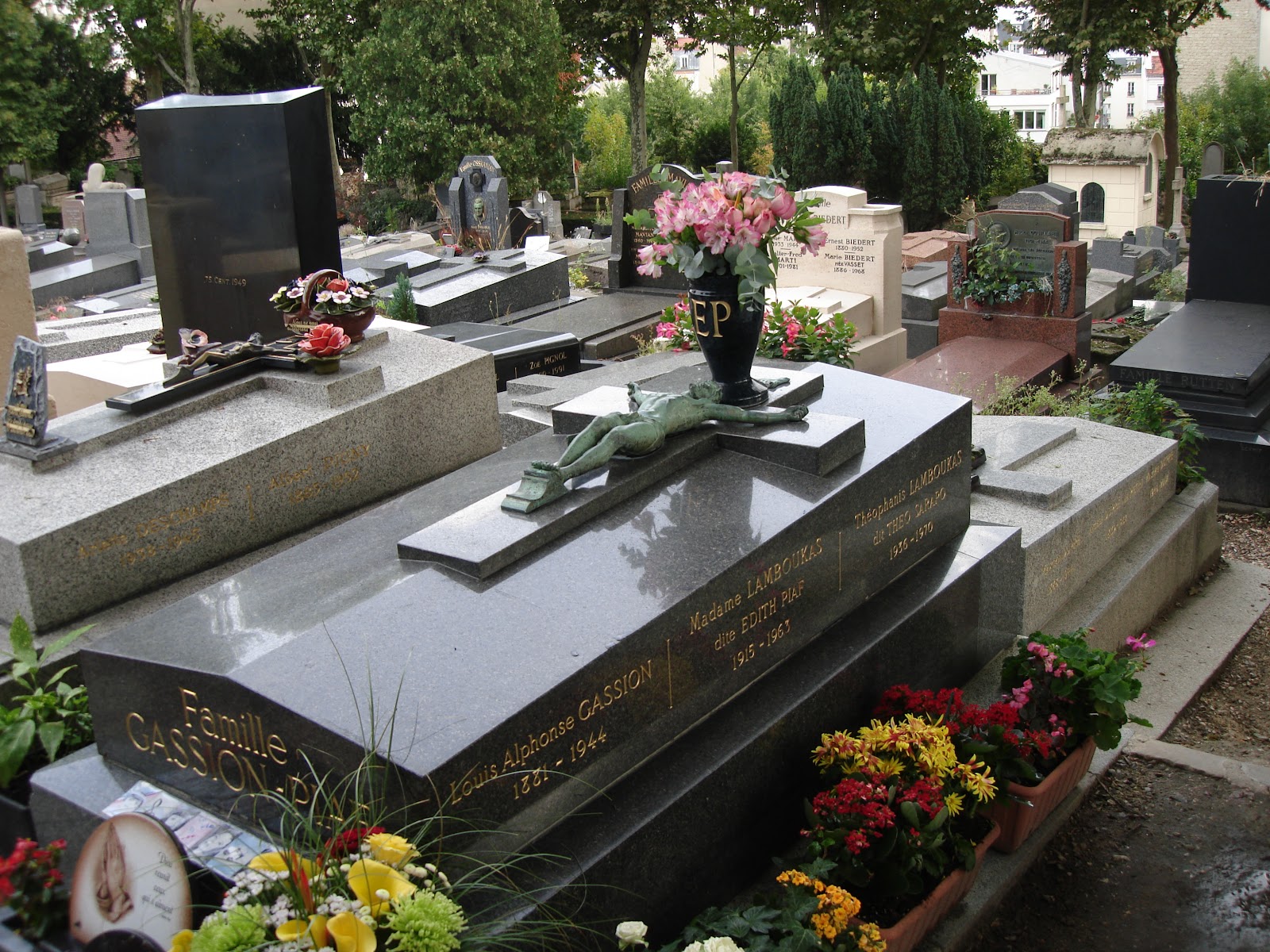
We used a map of the layout available at the entrance and walked down tree-lined roadways admiring the variety of large and small enclosures, some just big enough for a moments’ reflection.  The cobbles force you to walk a little slower than normal city  speed. There’s a crematorium and a memorial building on the grounds where we located the plaques of Stephane Grappelli, jazz violinist and the dancer, Isadora Duncan.


Edith Piaf, The Little Sparrow - by DG Hudson

We searched out Edith Piaf, the French chanteuse, Georges Bizet, writer of Carmen, and the poet/writer Oscar Wilde’s monument (we saw it covered in red kisses before the memorial was restored and partially covered by protective glass).  Refer to a previous post Paris Walks for the 'before' photo.  Chopin, Jim Morrison, Balzac, Sarah Bernhardt, Lalique, and many more rest in this same elegant neighbourhood.


Family monuments vary in design - by DG Hudson 2010


As the afternoon began to turn into evening, we left Cimetière du Père-Lachaise walking back the way we had come, down the sloped Rue du Chemin Vert, past the pop-up stores to the Place de La Bastille and finally to the Marais. 


A Closed Book - photo by DG Hudson 2010


Old cemeteries can be interesting places, aside from the spiritual value they offer, if you study the architecture, the placement of the old against the new, and the variety of detail on some of the monuments in these older places of rest. Imagine how it must have looked over two hundred years ago at its beginning, in 1804. Take photos to reinforce the memory when one day you want to use that setting in your writing.


The Cobbled Streets of Père Lachaise - by DG Hudson

***

References:

Oscar Wilde’s tomb is now partially encased in glass for its own protection and to honour his memory.  This video explains why. (Huffington Post article/video)

Virtual Tour of Père Lachaise Cemetery in Paris

All photos by DG Hudson, 2010 in Paris, France.

***

Have you visited a place or building that made a strong impression on you? Or gave you a feeling of deja vu?  Please share in the comments.

Monday, December 5, 2011

PARIS Walks

The Moulin Rouge, Montmartre, Paris - by DGH


Walking in Paris is the best way to discover the charm of the city, from the cafés tucked into the Ile St. Louis, to the bridges that cross the Seine River. From pop-up stores to a hidden vineyard in Montmartre, from a graffiti wall to a bit of old Rome underground, something unique is waiting around every corner. Our daily walking on average was five to six miles with café breaks. Wear comfortable shoes, and watch the locals when crossing the streets then, do as they do.


Walking tour of Montmartre (a booked tour)


The Moulin Rouge sits across from a Starbucks in Montmartre and seems less glitzy by day. The big red windmill serves as a landmark, as does the wooden Moulin Galette further up the hill. Full scale dinner shows can be booked at the Moulin Rouge through tour agencies. We paused here to take a photo as we walked up the Rue Caulaincourt to meet the tour group of 12 people near the Blanche Metro station. After all, an icon is an icon.
 

Au Lapin Agile, an original cabaret /café from the past that in earlier times was known to allow the exchange of art as payment for food & drink. It helped the artists and gave the art more exposure.


Le Bateau Lavoir, the studio and sleeping quarters of many artists, including young Pablo Picasso, was one of the sights our tour guide stopped to talk about. At the height of the studio’s usage, beds were used in shifts in the shared accommodations so the artists struggling to make ends meet could stay in Paris.


Le Bateau Lavoir - Paris - by DG Hudson


The Wall Passer, a sculptural representation of a character from a local Paris story that tells of a man who could pass through walls; the work was commissioned to honour the local writer who lived in the area (Marcel Aymé).


The Wall-Passer, Montmartre, Paris - by DG Hudson


Sacré-Coeur Basilica sits majestically at the top of Montmartre, fronted by wide steps for relaxing and observing the city of Paris spread at your feet. You can visit the ever-white stone cathedral that has offered shelter for over a century, or you can begin the steep descent down the hill, past street buskers, petition hustlers and old style cafés.

Head East from the Marais. . .


The Cimetière du Père Lachaise is in the 20th Arrondisement; we walked from the 4th (the Marais) past the Place de la Bastille, and up to the Rue du Chemin Vert. The trip covered 2.5 kilometers, uphill but manageable.


This cemetery was the final home for some celebrities: Edith Piaf, Oscar Wilde, Chopin, Jim Morrison, Stephane Grappelli, Isadora Duncan, and Georges Bizet. There are many others. Maps of the layout are available to help you find your way through the streets of cobbled stone -- each one approximately 4 inches square -- reminiscent of the Versailles courtyard.


Oscar Wilde's monument before the cleaning - by DGH

 Some traditions we noticed from the locals and tourists: leaving a rose on Edith Piaf’s grave, leaving a pebble or other item on grave markers as if to say ‘I was here’, leaving a red kiss on Oscar Wilde’s monument -- BUT this last one is no longer allowed, now the bottom half has been encased in glass to prevent damage to the stone through two mediums: waterproof lipstick and graffiti pens.


Latin Quarter

The Church of St. Germaine des Pres, situated near Les Deux Magots is the oldest church in Paris, built in 542 AD, and it retains one of the original bell towers.


Les Deux Magots and Café de Flore

Two well-known cafés in the Latin Quarter are famous for their past lives as  gathering places for the Lost generation and the Existentialists (and a lot of writers were in those two camps).  They have always enjoyed a friendly competition in vying for the students and the literary crowd.  Prices are higher here, according to a local insider. You go for the atmosphere and for the history, all the while hoping to absorb some of the literary magic that hangs in the air of these two cafés.  Think Midnight in Paris and go from there. . .

 Île de la Cité


Notre Dame Cathedral (Our Lady of Paris)


Visitors and locals lounge around the square facing Notre Dame enjoying the statue of Charlemagne, the people, and the pigeons.  Others, visibly identifiable as tourists, contemplate whether it's worth the climb of 400 steps or more for a photo opportunity.


This is the oldest spot in Paris. When the Romans arrived, the Parisii lived here.  A circle design embedded in the square facing the church identifies the exact Centre of Paris. It’s made of brass which is set into granite, then into concrete.  Most of the visitors missed seeing this important spot, simply because they were too busy looking at everything else.


Notre Dame Cathedral, Paris - by DG Hudson


Crypt Archeologique (Roman Ruins, and the Parisii)


This underground museum sits under the square fronting Notre Dame, protecting ruins of the Roman city of Lutetia, and the original settlement of the Parisii.  The lighting is designed to highlight the structures and information is available on each part of the exhibit.  A must-see if you’re a Roman history buff.


Roman excavation in the Crypte Archiologique - by DGH

***

Have you explored a city by walking through the streets?  If so, what city?

The Centre of Paris, Notre Dame Square by DGH


Monday, October 31, 2011

Paris Gilt Trip


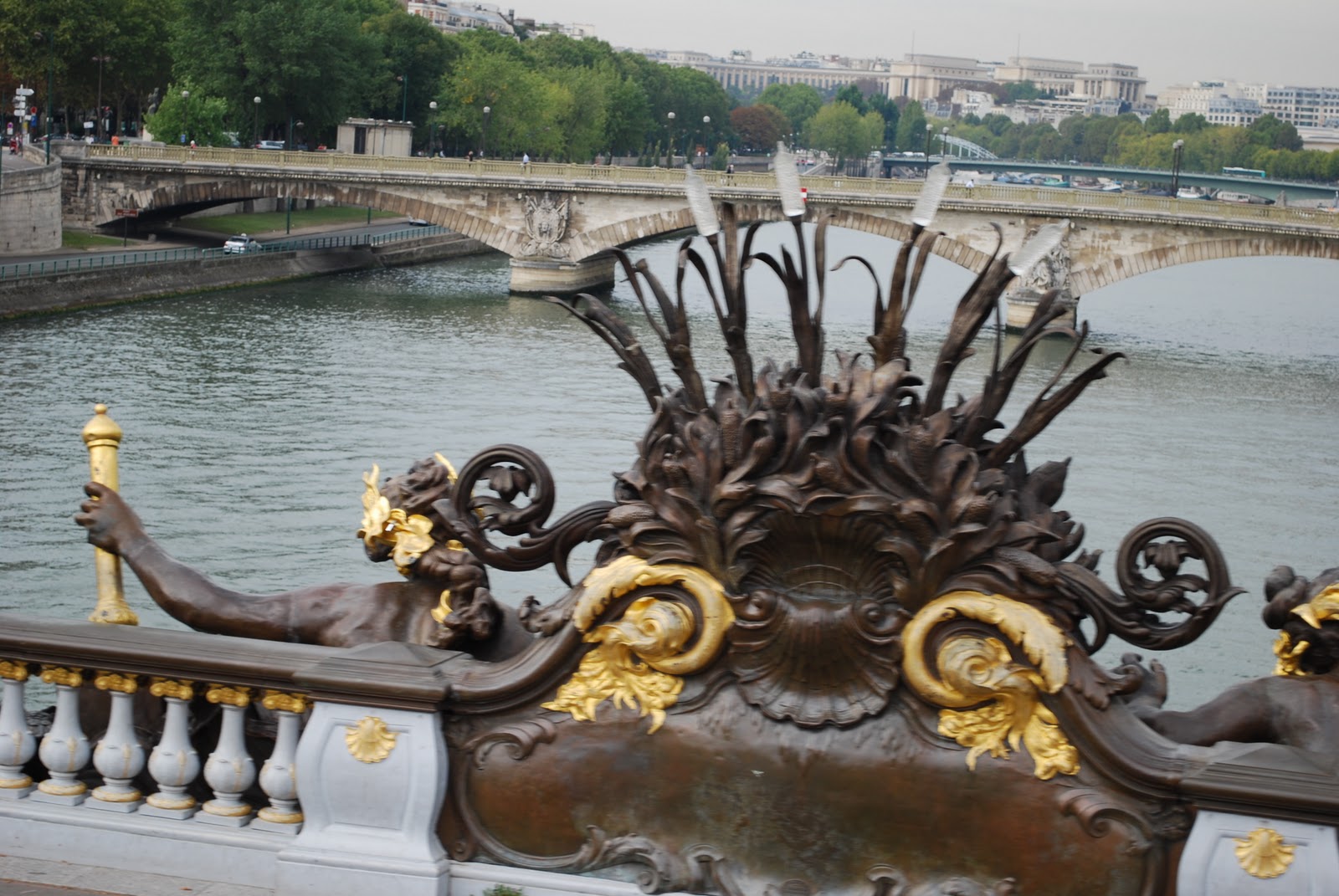
Traveling in the City of Light, you can’t help but notice the wide variation in the guilded sculptures adorning the Seine River bridges, light stanchions, and 16th and 17th century buildings.  On a sunny day, you might need sunglasses.  After visiting Paris, I can fully appreciate the effect of gilding.  The French take special care of their monuments and their past.  Following below is my evidence supporting that statement.


Versailles  

This palace seems to be dipped in gold decoration, which enhances the front entrance street appeal. It’s the approach that humbles you. The cobblestones were set in place in such a way as to slow down the horse-drawn carriages and those walking so that they could properly approach the palace of the king. At least, that’s what I heard. . .

Built to house 3000+ nobles, their families and caretakers, including the king and his retinue, Versailles was like a small village for Louis’ court. Statuary, fountains and gardens in the back were part of the entertainment for the court and allowed the king to keep watch on them all.  The Hall of Mirrors, where you can see forever, might have served the same purpose.

Down side: When we were at Versailles, there was a jarring juxtaposition of modern art being integrated into the French interiors. It didn’t work. Even some of the tour guides admitted that the effect was garish.  Exhibitions of this type are allowed to provide additional funds for expert restoration and repair, and general trust expenses.


The Louvre Museum


This beautiful museum was a palace first, before it became an art museum and it shows in the details. It’s also shown in the basement where the foundations of the original Louvre palace can be seen, with a model of the medieval palace.


Paintings of all sizes, sculpture, historical artifacts, and a trove of antiquity collections surround you.  Various coloured marbles, painting and gilt cover the walls and ceilings. What a feast for the eyes and a photographer's dream - you can take photos in this museum.  We saw Winged Victory, Venus de Milo, and Mona Lisa before we started sinking into Antiquity.


Although we spent nearly five hours meandering through the exhibitions, we didn’t see all that we wanted to see. We did our own walking tour after buying their floor map of the exhibits. It's difficult to get a close look at the art in a tour group. This is important if you want photos like we did. I recommend plotting your own path through this art heaven.


Bridges (Ponts), Lampposts and Fountain Embellishments

Perhaps the gilding lends a romantic aura on these places, favourites of lovers sharing a kiss. Certain bridges, like the Pont D’Iena by the Eiffel Tower, have more complex architectural designs which offer gilding opportunities.  History can be preserved, and these places prove it.


Opera Garnier


The name of this opera house refers to the architect who designed the building. It was the setting for the Phantom of the Opera and still survives in grand style. Gilded sculpture tops the roof and highlights the busts of musicians on the front of the building. 


We found out - too late - that there are tours of this building when the opera isn’t performing.  Photo detail in upper right on this post.  There are images available on the Paris tour sites if you're interested.


Joan D’Arc, on the Rue de Rivoli

This statue of Joan stands in front of the Hotel Regina, just down from the Louvre Museum on the Rue de Rivoli. She has a majestic presence over the traffic which faces her on the opposite side of the street. Gilded from head to toe, she and the horse remind us of another era in the French past.  I like this commanding sculpture of the French heroine.


A Gold Mime, on the Pont D’Iena (near the Eiffel Tower)

Sitting on the Pont D’Iena, we saw the golden mime, waiting for someone or something. He wouldn’t say.


To ‘gild the lily’ is to try and improve on what is already beautiful. Paris seems to have it right.

All the photos taken Autumn 2010 in Paris by DG Hudson. 

***

Do you notice architecture? Any favourite buildings?

Friday, October 7, 2011

Duty vs. the Self - Finding Time


Grande Palais Fountain, Paris 2010 - Photo by Green Eye


My favourite time to write is in the morning, when it’s quiet and the birds are just starting to chirp.  I don’t always get to do my writing then, as there are other duties that are demanding my attention. We all have those obligations. Many of the decisions we make about our use of time are based on our sense of duty or necessity.


The Wall-Passer, Montmartre, Paris 2010 - by DGH


Every day, we decide when and which Duty things will be done: going to work, household tasks, visiting elderly relatives, driving the kids, volunteering, etc. Some we do as part of our routine, but because we fixate on getting the duties done, we forget that we need ‘time out’ for the Self. Our sense of cognitive dissonance (discord) becomes agitated when we push our own needs aside. There’s no need to abandon your duties, just make ‘time for yourself’ one of those duties.

Self-time is whatever restores your sense of equilibrium. Writing does it for me, and I find that I get annoyed when my time is hijacked by those ever present duties. When I take the time for an activity I enjoy, it benefits me in several ways. I distance myself from the problems, the worries, and the annoying things; I lose myself in the act of creating something for the pure challenge of it. The problems don’t go away, but I forget about them for a while.


Sacré Coeur, Montmartre, Paris, by DGH 2010


We each have to find that balance in our life, even though the variables are ever-changing. Make the effort to spare a little time for yourself, you’ll be glad you did.

***

What sparked this post:


In Hope Clark’s post, My Fiction Day (Oct 5, 2011) . . . she talks about when she writes best, and why. Her words started me thinking about my own time to write, and how difficult it was initially to carve out that time.

Her post is an interesting look at one busy writer’s schedule. Check it out at her blog: http://hopeclark.blogspot.com/2011/10/my-fiction-day-when-it-flows-and-when-i.html

***
A Musical Interlude:


A YouTube video of a song by James Brown, with his advice: ‘. . .you got to live for yourself, yourself and nobody else’. . .)  It may sound a little narcissistic, but the point is, don’t neglect yourself.

I’ll Go Crazy, by James Brown, R & B artist.

http://www.youtube.com/watch?v=XsxEfmhmDXg  (music only)

***

Do you make time for yourself? How do you manage it?

Thursday, September 1, 2011

Strong Women in Culture


What did these women have in common? A strong sense of self and enough confidence to pursue their dreams. They lived in different times, and sought their own way, oblivious to those who said they couldn’t.

French Flag in the Arc de Triomphe, by Green Eye

Simone de Beauvoir - (1908 - 1986) France
Philosophy and Literature  
Compatriot of Jean-Paul Sartre, professor at the Sorbonne in Paris, and a member of the early existentialist movement, she examined women’s rights and through that, influenced a generation of women. In her book, The Second Sex, feminism was defined.
 Many of the feminist ideals of the 1960s and afterwards found their roots in the writings and musings of de Beauvoir. All through her life, her attitudes, her writings and her relationships were under scrutiny. She said she lived her life to please herself, not to please others.

After Jean-Paul Sartre passed on, Simone had to recover.  His sickness had depleted her reserves.  Simone still showed that pragmatic frame of mind in an interview in the mid-1980s. She was more interested in ensuring that Sartre’s unpublished writings made the light of day than in continuing her own writing.
Her reply to why she wasn’t interested in writing more about her own work: “In a creative profession, one does what one feels like doing. ... It takes inspiration to create...”
For more information:
Ref:  Article, Who's News, New Woman Magazine, July 1984.

***

Totem Poles in Stanley Park, Vancouver - by DGH


Emily Carr -  (1871 –1945) Canada
Artist and Author

Growing up in Victorian times, Emily survived by using her own wits, and running a rooming house (with help) in Victoria BC; she had her studio in the upper quarters of that same house on the main street near the current site of the Empress Hotel.


She travelled to the Queen Charlottes (now called Haida Gwaii), north of Vancouver Island, BC, lived in the area and painted many of her famous Northwest Coast totem and forest paintings while immersing herself in the culture of the Haida natives. Her art showed the raw beauty of western Canada when viewed through the lens of a perceptive artist, she tried to capture the spirit of the huge towering evergreens and of the carved traditional totems. An art school, the Emily Carr University of Art and Design in Vancouver, bears her name. 

http://en.wikipedia.org/wiki/Emily_Carr

***

Pere Lachaise Cimetière - Paris - by DGH


Isadora Duncan - (1877 - 1927) USA
Dancer; forerunner of interpretive modern dance
Isadora’s style was much more appreciated in France and Europe, she was too modern for North America in 1899.  Her choreography and movements set the stage for modern dance. She had the audience on their feet when she danced to the Marseilles in France. The fluidity of her movements came from a mixture of various dances and from the sheer, flowing fabrics she wore.


One of these, a long scarf, was blamed for her untimely death in 1927 when it caught on the spokes of a Bugatti wheel in Nice, France.  She rests in the Pere Lachaise Cimetière in Paris, France, near violinist Stephane Grappelli and in the company of other residents Oscar Wilde, Edith Piaf, Georges Bizet, and Jim Morrison. We checked in 2010 and none had changed their addresses.


Ref: http://en.wikipedia.org/wiki/Isadora_Duncan

***

Lena Horne - (1917 - 2010) USA
Singer & Actor

An American singer foremost, as well as an actor in early movies showcasing the music popular in the 20s, and 30s, the music coming from Harlem and places like the Apollo Theatre. She had more class and sass than most.

Lena was a mix of African American, Native American, and European American, and lived in an upper middle class stratum of educated sensibilities. Her political views and her involvement with the Civil Rights movement illustrated that she was no shrinking violet.

Outspoken, and fighting for the rights of those less fortunate, she battled the mores and the attitudes of the day, getting blacklisted by an industry too dependent on government approval. She survived into the 21st century, but her voice singing “Stormy Weather” will be with us always.


Ref: http://en.wikipedia.org/wiki/Lena_Horne

Ref: http://www.youtube.com/watch?v=QCG3kJtQBKo
(Lena singing Stormy Weather)

***
These four diverse women influenced many other women during their lives as well as afterwards through their books, or the changes they helped bring about.   There are many more and they come from many countries.

Never underestimate the power of a woman with a goal in mind. 

Have you been affected or influenced by a particular woman's story? Or has there been a woman in your life that made a difference in how you perceive others or yourself?

We can't all lead armies, but some of us are good at it.

Joan of Arc, near the Louvre in Paris  - by DGH

Sunday, July 24, 2011

The Chronic Pain of CVS


Sculpture by O. Zadkine, Paris - photo by Green Eye

  CVS = Cyclic vomiting syndrome


Cyclic vomiting syndrome (US English) or cyclical vomiting syndrome (UK English) (CVS) is a condition whose symptoms are recurring attacks of intense nausea, vomiting and sometimes abdominal pain and/or headaches or migraines. Cyclic vomiting usually develops during childhood at ages 3–7; although it often remits during adolescence, it can persist into adult life. (Wikipedia definition, link below post)
 ***

The young woman awakes, hoping for ‘normal’ but fearing the worst. Will there be more gut-wrenching pain that wraps around from the stomach to the back, and the unbidden nausea that is a chronic side effect? On a good day, she will be able to get up early or mid-morning and eat breakfast. If that poses no problem, then she may be able to do some household chores, or even work when that occurs. When it’s a bad day, everything squeals to a halt until the pain is attended to or runs its course for one to several days.


For relief and the ability to do the basic things, she has medications to help quell the effects of the CVS syndrome. There are pain medications prescribed including nose sprays or pills that melt in the mouth, hydration to replace the lost fluid, and nausea pills. Sometimes a combination of these will work and sometimes they won’t. As a last resort, the doctor’s office will administer a shot to stop the spasms of the stomach. Sleeping for several hours is usually needed to recover from an intense bout, or incidences that last longer than three days.

A mild attack of CVS will last one day, but the length of time can vary depending on other factors that come into play. Hormone fluctuation, stress, a lowered immune system due to a cold, lack of sleep/insomnia -- any of these can trigger the start of the pain spasms in the stomach. One doctor said we all get butterflies in our stomach, but a person with CVS gets “tigers” in their stomach.

There are websites for this rare condition, but no cure that this young woman has been able to find. Managing the disease may be an ongoing factor in her life, even though some believe that the frequency and intensity will reduce, if not disappear at certain ages, e.g., after puberty, in early adulthood, etc. That hasn’t happened yet. Various tests can be scheduled to check the condition of the stomach. Other tests which must be done in a hospital, such as scoping of the upper or lower digestive system, are sometimes required after other causes such as ulcers are ruled out.

All the basic mundane things that we have to do everyday become a real chore when the body fights itself, or causes intense pain. When that pain is internal and not visible like a wound, others can doubt its validity, forcing the person who is ill to be constantly on the defense.

CVS affects males and females, with more incidences occurring in the female gender. That may be due to the difficulty in diagnosing this rare condition that has symptoms common to several other diseases. The search will be ongoing to find better solutions, but finding support is difficult when costs are being cut in many health services. Researching several different mobile nursing services revealed that they aren’t prepared to take on-call requests for administering injections.
 
There are many voices in the cities that we don’t hear. This post is an attempt to promote understanding of this debilitating disease, by describing some of the challenges of the person coping with it. 

Sites to check for more detailed information:

Cyclic Vomiting Syndrome Association

Definition of the disease

National Digestive Diseases Information Clearinghouse (NDDIC) (US)

***
Reference Post: The Parent, the Child and the Disability (a parent's viewpoint)


NOTE: The name of the person referred to in this post has been withheld for privacy.

***

Mural in Vancouver, BC - photo by DGH