Tuesday, September 9, 2014

Pick Up Sticks, Hand-carved - A Photo Study

There are many uses for sticks, something any child and any dog can relate to.  Sticks appeal to anyone who needs the help of a walking stick, or likes one for hiking. Think Gandalf and wooden swords.

Hand carving produced these sticks shown here, a hobby that hubs just started doing in the summer of 2013 when we picked up a few branches that had fallen. After that, we acquired some more branches from a vacant lot next to a friend's house, and trimmings left near some of our walks. The wood used for these sticks was 'found' wood, not purchased.


A sampling of the Collection


Hand-Carved Wooden Swords, and Walking Sticks, photo by DG Hudson


There are three wooden swords in the first photo, and hubs has also fashioned a few wooden knives, suitable for use as props perhaps. There were drumsticks for a musician friend, and magic wands for those who needed one. (we are Harry Potter fans. . .) He liked the creation process and everything was hand done, carefully hand-sanded, stained with tea stain or for the dark areas, a purchased stain. Each is protected with a varnish finish to protect the stain and provide some weatherproofing.


***

Details

Detail of carved sticks, photo by DG Hudson


The yellow stain on some of the tops of the sticks, in the photo below, was created by soaking a few threads of saffron in water and using that as a stain. Depending on the amount of tea stain applied, nice shadowing results on the natural air-dried wood. Some effects result from leaving the layer underneath the outer bark in place, as it will retain the stain differently.


Carved wood collection, prop of DG Hudson


More Detail 

Basic Staffs and Walking sticks, photo by DG Hudson


These photos illustrate something you can do to occupy idle hands or just for the thrill of hand-carving something that is pleasant to look at and possibly useful. I had planned to show these prior to hubs' illness, as he agreed. We are not taking orders or selling anything, this is simply a sharing of hobby ideas. I am the recipient of two walking sticks and one French style sword. The time may come when I need them. . .

***
Do you have a hobby or skill that you use to produce gifts or interesting things? Do you like walking sticks or a staff (like Gandalf used)? 

Please leave a comment to let me know you were here and I'll respond. Thanks for dropping by!

***

Tuesday, September 2, 2014

PARIS - Aerial Street Views and the Étoile


From the Arc de Triomphe and the Étoile, the pattern of the streets radiate outward and buildings must adapt. The trimmed chestnut trees lining the boulevards soften the effect until winter comes.


Paris - Streets and Architecture from the Arc de Triomphe by DG Hudson


The Étoile (renamed the Place Charles de Gaulle*) forms the center with the Arc de Triomphe rising majestically above. Architectural conformity creates pie-shaped wedges, altogether a pleasing pattern from above, and not as noticeable at ground level. In the top horizon on the left of the photo above is the hill of Montmartre and the outline of Sacre Coeur.

***

The Long View


The straight line effect was intentional to allow a free flow of military parades and were part of the Haussmann plan for fixing some of Paris' major convoluted streets. Georges-Eugène Haussmann, commonly known as Baron Haussmann was appointed by Napoleon III to renovate the older streets. 

Wide boulevards allowed the military good line of sight and eradicated unwanted elements of society along with decaying buildings and impassable winding streets. Originally these accommodated carriages and later vehicles as seen in the images.

***

A sense of order


On the left in the image above, you see the stone edges of the Arc de Triomphe top level as I needed to photograph between the restraining bars on the top level of the monument.


***

At ground level

Back on the street, this is what it looks as you circle the Arc de Triomphe on left. Round and round they go, with up to ten lanes of determined drivers. This is an orderly version shown below. (One driver told us, you must be somewhat aggressive, and pretend you don't see the other drivers. That sounds like a lot of places. . .)


NotePlace Charles de Gaulle came into existence as the Étoile, translated as 'Square of the Star' and includes the Champs-Élysées. It was renamed in 1970 after the death of General and President Charles de Gaulle. It is still referred to by many using it's original name, and a nearby metro station shows 'Charles de Gaulle - Étoile'. The historical axis of the monuments (Axe historique) cuts through the center of the Arc de Triomphe.


****
Do you like aerial views? Are you interested in the layout of various cities, and how architecture can emphasize the design? Would you climb the 300 plus steps to get to the top for these views?

Please leave a comment to let me know you were here, and I'll respond. Thanks for dropping by!

***
References

http://en.wikipedia.org/wiki/Place_Charles_de_Gaulle Place Charles de Gaulle or Étoile

http://en.wikipedia.org/wiki/Georges-Eug%C3%A8ne_Haussmann Details on Haussmann

***

Friday, August 22, 2014

Environmental Concerns - Protect the Waters

Industry or the Environment?

Since oil companies can't promise they can contain and clean up a spill (in a volatile moving source like rivers, inlets and oceans), why was the approval given to Northern Gateway pipeline in June? That set the stage for a contest of wills.

Our lands, waterways and coastal areas in British Columbia will suffer the aftermath of any problem resulting from 'accidents', not the companies or provinces wanting a corridor to the shipping facilities. Spills and leaks happen. Cleanup and dealing with the aftermath can take a long, long time. Finding someone to take responsibility for the problem involves much finger pointing and shifting of blame.


Harbour Waters, Vancouver, BC, by DG Hudson


Whose water is it?

There are some who care what an oil spill might do to a community of people who depend on the waters and its cleanliness. The Nak'azdli First Nation is one of the groups that would be at risk. A battle will ensue between the industry and those who believe we should protect the resources from government and development intervention.

The climate is already changing. Do we want to hasten it by giving industry the chance to further pollute the waters we and other species depend upon? Shipping containers and tankers have developed leaks for various reasons. Does anyone inspect them other than their owners?  'Oops, mea culpa' is not good enough.

Note: The inspiration for this post came from the Vancouver Sun newspaper reference shown below.

***

The Stuart River

Located in central British Columbia west of Prince George, the Stuart River flows over 110 km from Stuart Lake to its junction with the Nechako River. The river drains off a portion of the Nechako Plateau.

This area is a wildlife habitat with deer, moose, elk, and trumpeter swans. In the river are sturgeon and high-quality sockeye salmon. This is also an area rich in history and archaeological sites of First Nations Carrier people. An ancient village exists near the joining of the Nechako and Stuart rivers.

Historically, the Stuart River was the route used by explorer Simon Fraser and the New Caledonia fur traders. Paddlewheelers plied the rivers in the early 1900s to supply the nearby Fort St. James and other fur trading outposts. It is also the home of the Nak'azdli First Nation.

***
Freighter in the Harbour, taken from Ferry, by DG Hudson


What do you think about it? Is the prevailing attitude to let the following generations worry about it?

Please leave a comment to let me know you were here, and I'll respond. Thanks for dropping by!
 
***

References:

The Stuart River
http://www.env.gov.bc.ca/bcparks/heritage_rivers_program/bc_rivers/stuart_river.html

Newspaper article
The Vancouver Sun, front page news, Saturday, August 16, 2014.  Centre of Gateway resistance, The Nak'azdli First Nation is part of the Alliance opposed to Enbridge's Northern Gateway oil pipeline. Also: There will be no pipeline, section A10, by Gord Hoekstra, also in The Vancouver Sun.

http://www.env.gov.bc.ca/bcparks/heritage_rivers_program/ British Columbia Heritage Rivers Program

***

Monday, August 4, 2014

Location in Photography - What does it tell us?

Places can suggest story ideas or speculate on the people who inhabit these areas.

Up in these heights. . .wildlife roams and humans on the run hide in the heavily treed crevasses. Hunters and trackers know these mountains.


Winter Landscape near Merritt, BC, Canada, by DG Hudson
 

The color image above of British Columbia interior mountains looks as if it's black and white or Monochrome. As for the weather, it was a very grey day sapping the skies of the sun that would highlight the color of the evergreens.

***

A Bridge runs above this scene

Steam is the only thing moving in the railway yard image below.


Steam Engine, New Westminster, under Queensborough Bridge by Green Eye

Railcars on the left side appear to be either left for hook-and-haul rail companies OR it's rolling at a slow pace. Imagine the hissing of the steam and the huge steam engine motors amping up as the traffic roars across on the bridge above this scene.

What you don't show can be just as telling as what you choose to highlight.


***
Meet me at the General Store. . .

The equivalent of a corner store in the interior of British Columbia. That rectangular box looking thing is a telephone booth on the right side of the building, for those not recognizing such an entity. This is a combination gas pump, grocery and general store. A welcome site to the weary traveler or the locals coming for gas.


Winter at the General Store, Interior BC, by DG Hudson


What if there were a murder close to this location? What if the owner is the perpetrator? Or does the tracking team meet here to go into the mountains to look for the murderer in his hideout? That's what isolated locations suggest to me. . .maybe I've read too many suspense tales.

***

How much importance do you give to location?  Is setting or location important in your story? Do you photograph interesting sites for future use as inspiration or 'just in case'.

As a blogger, I always consider that I might want to use an image for a post.

Please leave a comment to let me know you were here. I'll respond!
I'm slow blogging and still trying to visit other blogs for August, as I tend to personal matters close to home. Also, a BIG thanks to those who have been so supportive regarding hubs. It helps.

****

Saturday, July 26, 2014

History - Fort Jefferson and the Dry Tortugas

An isolated fort 70 miles away from nearest land, a place where everything had to be brought by ship. This fort was established to be a guardian for the young USA.


Fort Jefferson
The Dry Tortugas


Lower Archways of  Ft. Jefferson, Dry Tortugas, by DG Hudson


The cannon slots in the end wall are narrowed to keep out the enemy's cannonballs, but the range of the cannons firing was limited from those locations. Wide areas such as those above were more suited to moving of military equipment and supplies within the structure.


***
Parade Ground and Courtyard
circa 2006
Fort Jefferson marching grounds, black Lighthouse on right, by DG Hudson


***

Two level archways in the rainy mist overlook deserted grounds at Fort Jefferson. Park employees live here for several weeks at a time to assist with tour information and oversee repairs and restoration. Hurricanes and storms have caused damage to the fort as recently as 2004.


Fort Jefferson, The Dry Tortugas, by DG Hudson


Fort Jefferson Moat

From this point of view, the fort does look like the prison that it was. High walls, small windows and a place for security guards to observe on the upper level. But where would any escapees go without a boat?


Fort Jefferson Moat, Dry Tortugas Nat'l Park by DG Hudson


***

Do you like to explore historical locations? Have you ever 'motored' south of Miami to Key West? Do you take adventure tours to offshore spots like the Dry Tortugas?

Please leave a comment to let me know you dropped by, and I'll respond. I'm blogging slower through the month of August, but I will post when I can.

***

References:

Wiki on the Dry Tortugas
http://en.wikipedia.org/wiki/Dry_Tortugas

For more blog information on Fort Jefferson refer to a previous post
Key West, Florida - A Vacation to Remember

More Fort Jefferson
http://en.wikipedia.org/wiki/Fort_Jefferson,_Florida

***

Tuesday, July 1, 2014

Photography - Capturing Animal and Bird Images

Frame, check focus and click. That's it. Take another image at a different angle, repeat. Before digital, photo bracketing helped ensure the photographer had several different light levels and poses. Taking several images of the subject will give you better photos if you change position or lighting in each. There are some things to be aware of while photographing--background, positioning of the subject, and point of view or angle of the camera. Here are some examples.

***

Scrape

This stallion's portrait was taken for the owner of the horse. He was in the process of training Scrape, since the young horse had a knack of getting himself into scrapes. . .  He's relaxed in this photo, because he's at home in his own corral, that's part of the fencing you see in the background. The natural setting keeps the image uncluttered.


'Scrape', Willie's horse, by DG Hudson


***

Waterfowl

Viewpoint can present an entirely different look, so try an overhead shot of the subjects. In this case, ducks indigenous to the Lower Mainland are feeding. Feather patterns and coloring become prominent. Centering the ducks is a great way to frame a motley group. Click quick as these subjects are very mobile.


Ducks by Neens; printed by permission 2014, DGH


Ducks are sociable, especially when food is being shared. These mallards and females stop long enough to pose. Framing this shot close to the action (duck-level) gives an immediacy to the viewer. The effusive color of the heads, bills and feet brightens the image. For professional use, you may want to crop out the human element, highlighting the main subject.


Mallards and Friends, by Neens; printed by permission 2014. DGH


***

In the photo shown below, the bird has been framed slightly off-center so the Sandhill Crane is prominent and the mallard is in the background. This photo is landscape oriented; use the portrait orientation if the subject is tall. Be quick when photographing nature. Try not to disturb them if they are feeding.  

I accidentally created a fantastic 'ducks in flight shot' by opening an automatic umbrella at our local lake, also a city bird sanctuary. A beautiful-to-humans, heart-stopping-to-ducks flutter arose at that end of the lake. I felt guilty scaring the ducks as the umbrella opened with a Whoosh! I felt even worse that I was holding the umbrella instead of my camera.

The images of waterfowl in the last three photos were taken by photographer Neens at a bird sanctuary in the Lower Mainland of Vancouver, B.C. Information follows.


Sandhill Crane, by Neens; printed by permission 2014, DGH


George C. Reifel Migratory Bird Sanctuary, is a protected area in Delta, British Columbia, Canada. This is a suburb of Vancouver and part of the estuary of the Fraser River. It is also a Site of Hemispheric Importance as designated by the Western Hemisphere Shorebird Reserve Network. (Wiki)

***

Do you visit bird sanctuary or animal preserves? Are there any in the area where you live? Do you look for nature shots on your runs/walks? Have you had your vacation time?

Please leave a comment to let me know you were here, and thanks for dropping by! I'll respond.

***

References:

Photo credit: Waterfowl photos printed by permission of Neens, the owner of these images.
 
Reifel Migratory Bird Sanctuary Wiki
http://en.wikipedia.org/wiki/George_C._Reifel_Migratory_Bird_Sanctuary 

***

Monday, June 23, 2014

VANCOUVER - Grouse Mountain and Carved Animals


Look North in Vancouver to see the nearby mountain lights hanging in the evening sky. Grouse Mountain is one set of lights in North Vancouver, located on the other side of the inlet.

Grouse Mountain

Exceeding 4000 ft. (1200 meters) in altitude at its peak, Grouse Mountain offers alpine skiing in the winter and hiking trails and other activities in summer and autumn. A breathtaking view awaits you. An occasional high-flyer is deposited via helicopter on the top of Grouse. Four chairlifts and 26 runs are approximately half an hour away from the city of Vancouver. The Grouse Grind is a popular trail for fitness enthusiasts, which runs directly up the fall line paralleling the gondola towers. Be sure to come prepared.


Grouse Mountain Tram, Vancouver's North Shore, by DG Hudson

Grouse Mountain had its first lodge built by hand by Scandinavians in the 1920s with wood they carted up themselves. In 1976, a second aerial tramway was built by 'Garaventa', which became known as the Super Skyride. This is now the main tramway, using much larger gondola cars and depositing passengers at a separate terminal. The main lodge is only accessible by tram, hiking trail or helicopter from the parking lot midway up the mountain.


***


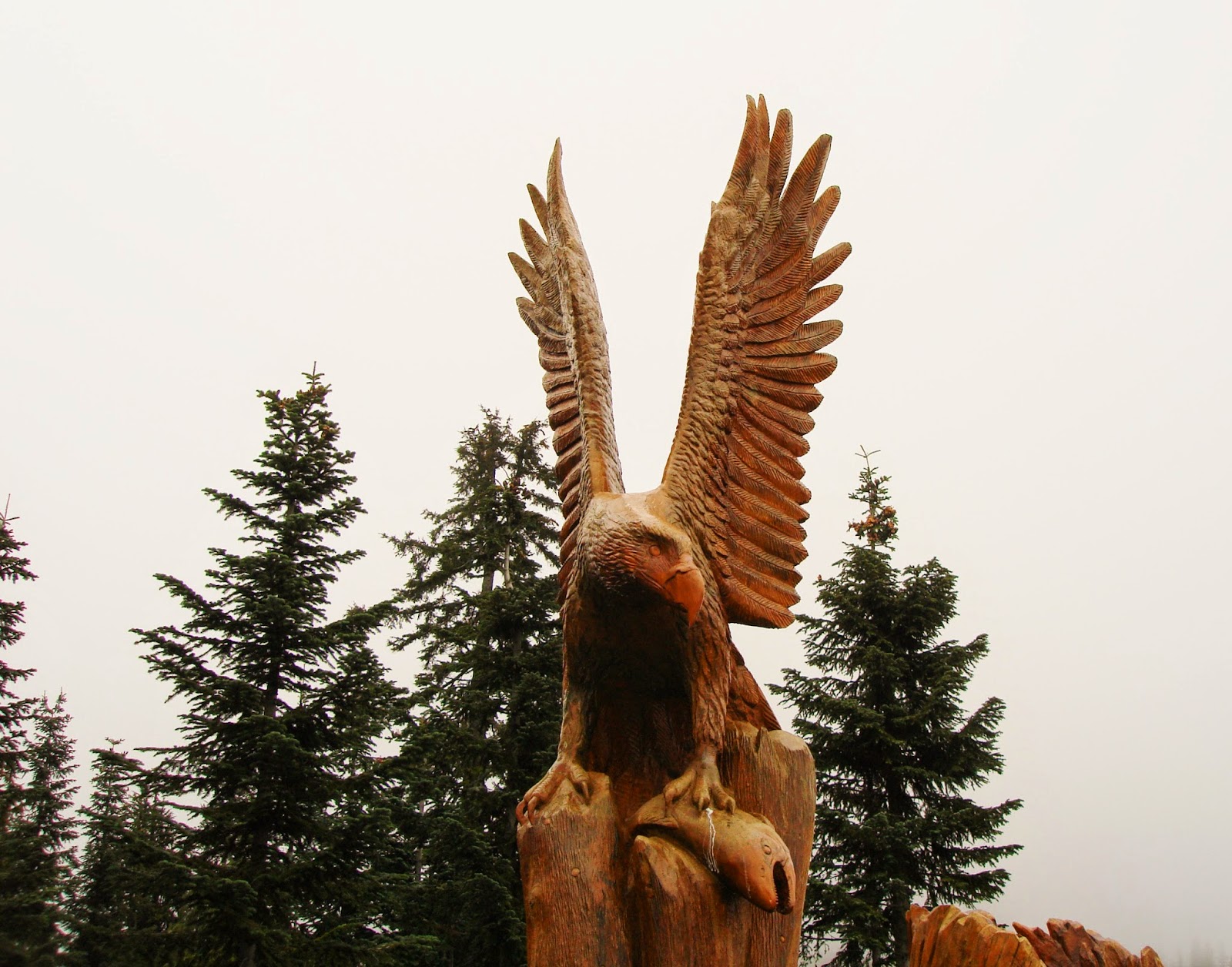
Chainsaw Wood Carving
Grouse Mountain
Lining the pathways between various activities


Wood carving of Bear with Salmon, Grouse Mtn., by DG Hudson


A picturesque location, Grouse Mountain has been used in several productions:

- 1994 The X-Files episode of 'Ascension'.  Actor Duchovny dangled from a gondola in one scene. 
- The ski lodge and facilities were used in filming the cartoon, Mr. Magoo.
- Nelly Furtado, singer-songwriter, filmed the video for Spirit Indestructible at Grouse Mountain.


Regal Eagle with Fish, Grouse Mtn, North Vancouver by DG Hudson


Always check the website to plan your visit to Grouse Mountain.


Carved Bear, Grouse Mountain, N. Vancouver, by DG Hudson


***

Have you seen or visited Grouse Mountain? Do you like aerial views or are they vertigo-inducing?
Do you remember the story of Paul Bunyan, a giant lumberjack in American folk tales? (Before chainsaws) OR Have you heard of 'Monty Python' lumberjacks?

Please leave a comment to let me know you were here, and thanks for stopping by. I'll respond!

***

References

A Monty Python skit of The Lumberjack song: Youtube
https://www.youtube.com/watch?v=5zey8567bcg&feature=kp 

Wiki of the song
http://en.wikipedia.org/wiki/The_Lumberjack_Song 

Wiki for Grouse Mountain
http://en.wikipedia.org/wiki/Grouse_Mountain 

The website
https://www.grousemountain.com/ 

***