Tuesday, November 20, 2012

Black and White Lens


Photographs in black and white appear somber, yet the image becomes dominant when color is no longer there to distract.  In the following photographs, I've included a bit of background information about each one.


Merritt Stampede 1936

A relative is in the first row of cowboys, second from the right, wearing a black outfit, and black hat on a black horse.  Notice the cars parked alongside the parade route.  A stampede is like a rodeo which includes western skills in races, roping and agility.  This was a time without television, so anything coming to town was exciting news.  Radio ruled.

Merritt, B.C., now sponsors Rodeo Fair Days, while larger cities such as Calgary, Alberta, hosts a much larger stampede event. 
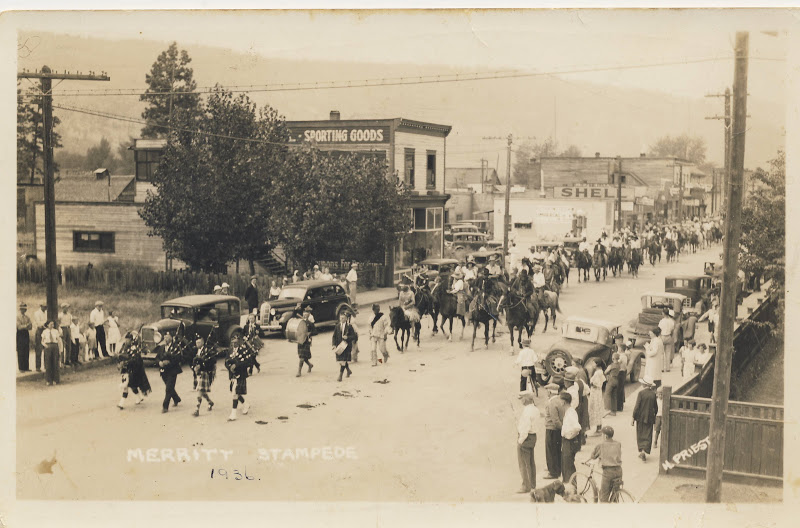

Merritt Stampede Parade, 1936, Local cowboys, prop. DGH Collection


***


The Royal Hudson

A special steam train previously operated by BC Railway and used for tours of the coastline between Vancouver and Squamish, B.C.  This class of steam engine, built in 1938, earned the title of 'royal' for its never-failing service to the royals during their cross-country tour in 1939.

King George VI and the queen consort, Elizabeth Bowes-Lyon (the Queen Mother) arrived in Canada on May 17, 1939.  Their train was a silver and blue 2850 steam engine.  The King allowed the name to be called the 'Royal Hudson' and to display Royal Crowns on the running boards.


The Royal Hudson 2860, 1940s Vintage Steam Engine, by Green Eye


***


Fort Jefferson

In 1846, a coastal fortress is built in the Dry Tortugas, 70 miles from the Florida Keys.

The arches shown below used some of the total 16 million bricks that were carted by ship from Boston, Massachusettes, to the Dry Tortugas. Small windows were set in the brick walls, narrowed for sighting of guns, and to prevent entry of enemy cannonballs.  Dripping water from rain and constant humidity leaves deposits of sediment on the corridor floor.


Dry Tortugas, Ft. Jefferson arched corridor, by DG Hudson


Fast-forward to 2006, when we went to the Dry Tortugas on a catamaran adventure tour.  See Key West, a previous post with more details.  Fort Jefferson, the monument, is an interesting place with a history connected to Abe Lincoln and his assassination, one of the dark times in American history.  When we were there, reconstruction was underway for some storm damaged sections.

http://www.nps.gov/drto/historyculture/fort-jefferson.htm


***

Do you like black and white photography?   OR do you prefer color?  Who doesn't like cowboys, trains or pirate islands?  Please share in the comments and thanks for stopping by.


****

References:

http://en.wikipedia.org/wiki/Royal_Hudson  - Royal Hudson Trains

http://en.wikipedia.org/wiki/Fort_Jefferson,_Florida - Fort Jefferson Monument

http://en.wikipedia.org/wiki/Dry_Tortugas_National_Park - The Dry Tortugas


****

Thursday, November 1, 2012

Country Girl comes to the City


Nellie had heard that jobs were plentiful in the big city of Vancouver.  When she graduated from the residential school, she wanted to see different places and meet different people.  Money was scarce on the reservation.  Even though her family and her siblings wanted her to stay, she bid them goodbye and left to make her way by herself.

***

Residential School graduate, prop. AHC

***

Her friendly smile and infinite sense of patience helped her charm the patrons at the Ovaltine Cafe, where she worked from the late 1930s to the early 1950s.  Hastings and Main was part of the downtown epicentre until the late forties.  There she met most of the local Vancouver Police officers who liked to stop by the cafe, and her future husband, a heavy duty mechanic from the prairies.

***

The Couple, in the late 1940s, prop. AHC


***
Two boys were born in the next few years and jobs opened on the Dew Line, the Distant Early Warning System that was being installed in the far north.  Her husband signed on.  During his early days of work at the site, the report indicated the plane had crashed within the Artic Circle.  He was believed dead.  Communications were practically nonexistent, especially in the cold winter months. There were no letters.


Devasted, Nellie moved back to her hometown and tried to look after her young children.  Life was hard, even with family nearby.  Enduring the cold winters, the resentment by others in the community, and the feeling of loss, she worked as a waitress to feed her kids.  The customers always liked Nellie.

***

Nellie, in hat, with friend at cafe , Vancouver,BC - AHC


***

Seven months later, E.W. was able to get a letter to Nellie and advised he was coming home.  He had not crashed, after all, but had been restricted from contact.  Back to Vancouver Nellie went, hiring on with the T. Eaton Company, where she worked until she retired at age 65.  Her two boys flourished in Vancouver, riding the streetcars and meeting mom for dinner after a movie on Saturdays.

Local gossip said that Nellie's dad helped catch one of those famous bank robbers in BC, but I can't say which one.  That would be another story.  Nellie's birthday is coming up later this month when she will be 97 years old.*  There's always a celebration at the care home, and her family visits with gifts.  A lovely lady who never gave up despite her setbacks.  She's one of those people who inspire me.


*Disclaimer: Names altered for privacy; based on true and fictitious facts. Photos, courtesy of family.

***

Do you have a relative or a friend like this, one you would like to celebrate?  If we don't tell some of their stories, who will?  Please share your thoughts on this in the comments.

***

Wednesday, October 24, 2012

Siegfried, Brunhilde and the Witch


Love Potion and a Dirty Trick
Never trust a woman whose mother is a witch.


Sigurd and Brynhildr's Funeral Pyre, by C. Butler, 1909 (PD*)


Siegfried and Brunhilde

In Icelandic and German mythology, Brunhilde was a strong, beautiful warrior princess and Valkyrie who was cruelly deceived by her lover, Siegfried.  She appears in the Icelandic Edda poems and in the Nibelungenlied epic of Germany.  Her name variations are Brunhild, Brunhilda, or Brynhildr.


Condemned to live the life of a mortal woman by Odin, and banished for displeasing him in a judgment call, Brunhilde sleeps under his curse.  Imprisoned in a castle, behind shielded walls, within a ring of fire, her body rests until the spell is broken.  Her only release is to be kissed by a hero who will cross the flames to reach her.  Cue Siegfried.  Love is born, promises exchanged, then Siegfried leaves, with that age-old promise to return.  The trouble begins when Siegfried meets Gudrun, the daughter of Grimhild, the witch/sorceress.


Grimhild prepared the potion that entrances Siegfried, making him forget Brunhilde and his vows.  He then compounds the problem by deceiving her. When she learns of the treachery from Gudrun, Brunhilde seeks revenge.  Siegfried is killed through her planning, after which Brunhilde joins him on the pyre that takes them to the other side.  There are variations on the events and the ending depending on the country of origin.  This legend bears witness to the following quote by William Congreve from The Morning Bride, a play from 1697. 


"Heaven has no rage like love to hatred turned, Nor hell a fury like a woman scorned."  This line is often misquoted as, "Hell hath no fury like a woman scorned." 


Legends can be based on events in history or local beliefs. Some legends have a moral lesson at the core. A legend can grow from a real event and others' retelling of what occurred, with embellishments added to suit their purpose. Were these early legends verbal teaching tools?

***

Are you familiar with the story of Siegfried and Brunhilde?  If not, how about another legend popular at Halloween, The Legend of the Sleepy Hollow, written in 1820? 

Please share what you think about legends in the comments.  Do you think they were used for teaching purposes?

***

References:

http://en.wikipedia.org/wiki/Brynhildr Warrior maiden Brynhildr

http://en.wikipedia.org/wiki/William_Congreve William Congreve

***

Credit Art Work: Sigurd and Brynhildr, by Charles Butler, painted in 1909, Wikipedia Commons, PD.  For details, see Creative Commons (art tags).  This photographic reproduction is therefore also considered to be in the public domain.  *PD = Public Domain

***

Saturday, September 29, 2012

Spirit Bears and Woolly Mammoths


Don't go down to the woods, today. . .


Mother Grizzly Bear and cubs at coastal Dump*, DGH Collection


In the Great Bear Rainforest, a vast area has been purchased to protect grizzly and black bears from trophy hunting enthusiasts. This purchase also protects the Kermode or spirit bears (black bears with white coats). A bear hunt has been banned this year by coastal First Nations from Haida Gwaii down the central coast of British Columbia. Other parts of the Great Bear Rainforest may not have these restrictions, check online for hiking and guide information.

Credit: The Vancouver Sun, Sept. 17, 2012, Environment, NGO buys bear hunting rights, by Judith Lavoie, Victoria Times Colonist. NGO=Non governmental organizations

Good news for the bears: The Raincoast Conservation Foundation now controls hunting in the heart of spirit bear country. (Size=28,000 sq km + 3500 newly acquired sq km.; measurements from news article)


***

Spirit Bears


The Kermode bear (kerr-MO-dee), or spirit bear is a subspecies of the American Black Bear. It's noted for one-tenth of their population having white or cream coats. The Kermode bear's range includes the north and central coast of British Columbia and inland toward Hazelton, BC.


A male Kermode bear can weigh 500 lb (225 kg) or more and stands 6 feet tall. Females are slightly smaller, weighing in at about 300 lb (135 kg). Spirit bears, because of their ghost-like appearance, hold a prominent place in the oral stories of the Canadian First Nations and Native American lore.
 

National Geographic estimates the spirit bear population to be between 400-1000 individual bears. In their information, they suggest "the spirit bear may owe its survival to the protective traditions of the First Nations, who never hunted the animals or spoke of them to fur trappers".


http://en.wikipedia.org/wiki/Kermode_bear Kermode Bear


*This photo shown previously in the post The Right Place - Must have been the Write Time on my Rainforest Writing blog.


****


Woolly Mammoths

 
Mammuthus primigenius: The woolly mammoth, or tundra mammoth is the last species of mammoth.

Woolly mammoth remains, which may contain living cells, have been discovered by an international science team in Siberia. Months of research will be needed before findings are conclusive, but what IF soft tissue DNA is found? Will cloning be far behind? These creatures are believed to have died out around 10,000 years ago, although small groups may have survived longer in Alaska and in Siberia.


Whether climatic change or overhunting by humans caused the mammoth's final demise in Earth's past, it's an amazing find for scientists today. I'll be watching for any news about the cloning part. Woolly mammoths were described in Jean Auel's Clan of the Cave Bear series.


Credit: Vancouver Sun, Science section, Sept. 12, 2012; Associated Press; Mammoth remains found in Siberian permafrost raise hopes for cloning.

***

Have you heard of spirit bears? What about cloning of the DNA of long-dead woolly mammoths? Do you remember Jurassic Park? Please share in the comments.


***

References:

http://en.wikipedia.org/wiki/Mammoth

http://en.wikipedia.org/wiki/Woolly_mammoth

***

Monday, September 10, 2012

What's Your Chocolate Blogfest

To get in the flavor of this blogfest on September 10th, think Chocolate.  What image does that conjure in your mind?


M.Pax, Laura Eno, Brinda Berry and Ciara Knight are hosting the What's Your Chocolate Blogfest.  You just have to talk chocolate, relate chocolate memories, and tell us about chocolate loves from your past:   chocolate fudge, chocolate dipped berries, chocolate liqueur, chocolate cheescake, handmade chocolates, and so on.  


What's my chocolate?  Dark Chocolate
and then, there's. . .

Too Much Chocolate

One chocolate dark night in early December years ago, we decided to make 150 truffle sized chocolates for Christmas gifts.  As novice chocolate makers, it took hours to shape that many fondants and dip each one into chocolate. We never made chocolates from scratch again.  At least two people are needed to make enough for several gifts, one person to dip the pre-made fondant shapes and one to grate the chocolate and keep it liquid for dipping. Although our place smelled sweet and chocolate-covered candies covered every surface, once was enough.  A true story.

***

Don't forget to answer the question. . . What's your Chocolate of choice?  Please share in the comments and thanks for stopping by.


To get back to the list of other bloggers participating in this Chocolate blogfest, click the link:

What's Your Chocolate Blogfest (M. Pax's site)

***

Saturday, September 1, 2012

Paris - Street Level Study


Near the Moulin Rouge, Starbucks in Montmartre, Paris.  A welcome break halfway to our destination. . .


Starbucks in Montmartre, Paris by Green Eye


***

The square cut cobbled stone of Pere Lachaise's streets in the autumn.  Step carefully, as this isn't a completely flat surface.   It forces a respectful pace.

***

Pere Lachaise cobblestones, Paris, by DG Hudson


***

The Eiffel Tower seen from ground level, the Trocadero in the lower centre of the photo. The blue building on the left is the entrance to the tower elevator.  


***

Paris advertising on the Champ Elysees using two images of Brigitte Bardot. 


Champ Elysses, Paris, by DG Hudson


Forever bronzed in his headlong stride, Winston Churchill walks to meet whatever challenge stands in his way. 


Winston Churchill in bronze, Paris, by DG Hudson


Sometimes, it's the little things that stand out in our memory.  For that, you need to be on the sidewalk, at street level. 

***

How do you remember your travels?  Do you keep notes, use a journal, record videos or photograph everything?  Please share in the comments. 


***

Two upcoming blogfests you should check out:

Sept.10, 2012:  MPax, Laura Eno, Brinda Berry, Ciara Knight,
What's Your Chocolate Blogfest

Sept. 17, 2012:  Alex J. Cavanaugh,  Genre Favourites Blogfest

***

Sunday, August 19, 2012

Time for Retrospect

Could you tell someone your life story? 

What were the main turning points?   Do you remember?  Here are some ways to collect those memories.  Retrospect means looking back.
 
Images (photos, video)

Visuals excite our brain as we try to identify what we see and match the image to personal memories.  Have you looked at old family photographs and wondered who those people were?  It takes a minute or two to identify who, when, where and what (event) on all visuals before we file them away.  Identify online with a caption or tag and group items together (the maternal or paternal side of the family, distant relatives, family or school reunions, family trips).


Vancouver, Burrard Inlet seals sunning, by DG Hudson

To get started, sort photos and gather paper collectibles in a storage container.  Discard or repack what you can't use, but retain a sample of concert programs, tickets, posters, sports books, travel maps, special cards or letters.  A flat-bed scanner is useful for enlarging the images taken with small format or older cameras.

Record Known Facts

-
Where the family name originates (both sides)
-Newspaper clipping of an event which helps establish time period
-Family tree known connections (use a template or record free hand)
-Heirlooms or special family treasures; include history, if available


Collect Memorabilia

Family get-togethers or summer visits with relatives are the ideal time to collect those memories by using your camera or getting someone else to do it for you.  Include a beloved t-shirt of your fave band, autographs, old school records or class photos.  Don't forget, this will be a cumulative project and you're the curator.


Mother-in-law c.1940s - DG Hudson Collection


Break the task into smaller chunks

Transcribing family stories can be done in small bits; determine main ideas and what you want to include.  Match photos to event.  Be creative in your display.  Make collages.  The final format can be print or digital, but consider whether you need multiple copies for any interested siblings or only one for your family. 


No gender specific skills required
 
Men and women can do this.  Quality of presentation is subjective.  I made a birthday photo album for BIL (brother-in-law) of his childhood and teen photos.  BIL was surprised and pleased seeing photos he had forgotten about.  Keeping track of memorabilia isn't always high on men's 'what to do' lists, but at least make a minimal effort.  You may be glad you did.  Blogger Arlee Bird recently wrote a post on storing some of these memory collectibles


***


Memory quilts (sewing skills required)

The design of a memory quilt should reflect the style of the person who will receive it.  What does that person like? Do they have a hobby or interest that suggests a theme?    You can design-your-own or purchase a pre-cut pattern at sewing stores.  I design my own layout and mix and match patterns with a related colour or theme.  To personalize, add applique to some squares and use needlework for the reverse of the quilt.  A very basic outline of steps for crafting a memory quilt follows.

Crafting a Memory Quilt

  • Make a list of elements to be included on memory side of quilt, calculate size required and purchase amount of fabric needed.  Play with design of front and back on paper first.  Use fabric and colour to enhance design.
  • Cut squares.  I used a pattern for 11in x 11in, (metric=28cm x 28cm).  The size of the squares will determine how many are needed for a finished quilt.  Photograph design layout after basic squares cut, this can be used as a reference. One side consists of 11 x 11 squares; the reverse side is a solid piece providing a background for personalization.
     
  • Stitch vertical rows of squares, then join the rows together to complete the large inner square section of the front.  Applique and machine stitching detail are added at this stage.
  • Design the needlework needed for the back memory part of the quilt. (freehand or stencils). Complete needlework stitching.  Tiny sew-on charms, heritage lace, buttons or antique doilies can be used as embellishment. 
  • Sandwich the front and back together, overlapping back to front to form the edge binding.  Add basic stitches by machine or hand to secure the front, back and fiberfill layer.  Voila!  (That's the short story.)
  • Handwashing the quilt is recommended particularly if some items are vintage. 
  
***

Destroyed or overused Baby books or albums

They can be salvaged.  Take apart at the binding, carefully cutting the pages along the spine with a sharp knife.  Each page can be inserted into the top opening clear pocket pages of a scrapbook.   Other small collectibles can be kept in these as well ( a lock of baby hair, a baby bracelet, etc.)

***

Additional References:

It's Your Life - Prove it!  Ideas and Information to get you started from an earlier post of mine.

Check out Arlee Bird's blog, Wrote by Rote for more ideas about memoirs and taking care of family history.

***